The company grew by teaching people how things work person to person. There might be some documentation floating around, but there's no standardized onboarding, no training structure, no checklists or workflows anyone can point to. Often there isn't a central place where any of it lives at all.
What does exist is scattered across individual computers, shared drives, and emails from three months ago. So when a new hire starts, everyone scrambles to pull together what they need. It works, more or less, for that one hire. But nothing gets captured for next time — which means the same scramble happens again with the next one, and the one after that.
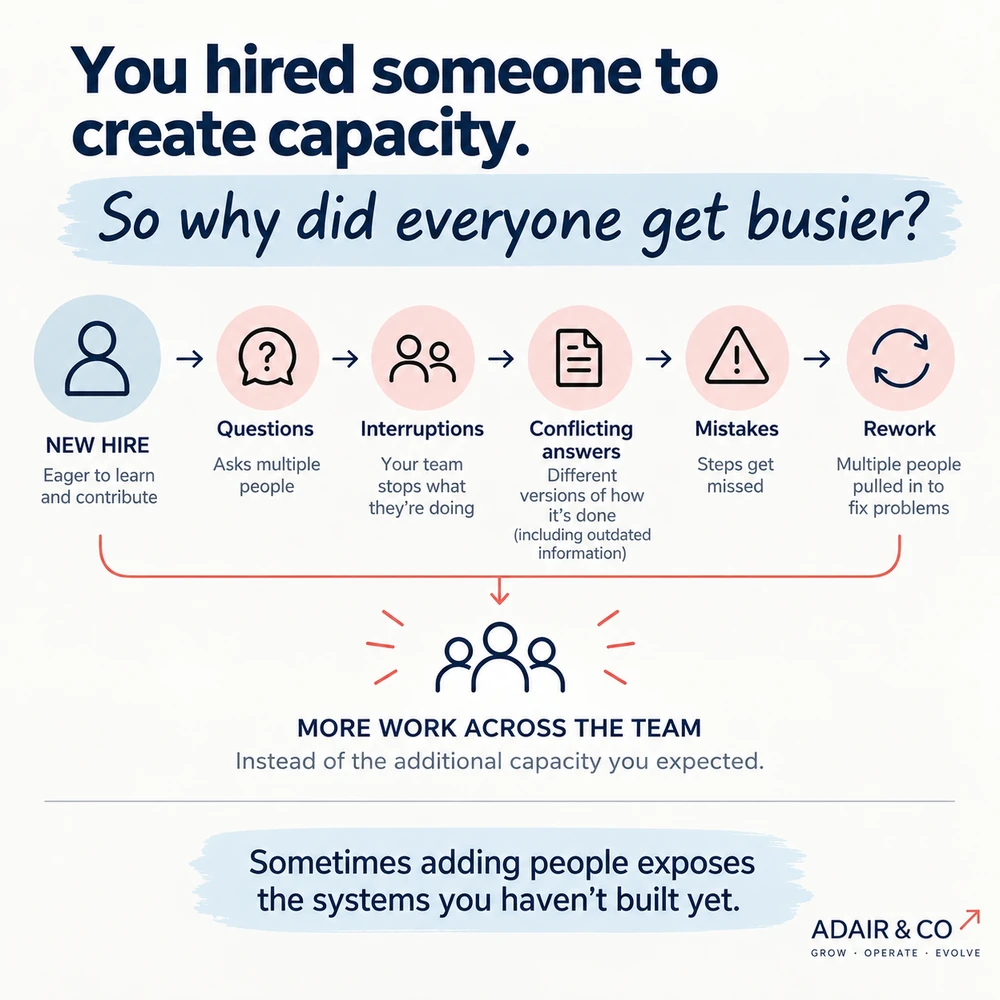
They learn the only way they can: by asking questions. Lots of them, usually of several different people, who each have to stop what they're doing to answer. That's a real cost, even when it looks like normal onboarding.
Sometimes they ask their manager, do exactly what they're told, and still get it wrong — because the process changed six months ago and the manager didn't know either. Now you've got different people operating from different versions of how the business actually works, and no one can tell you which version is current.
Not in training. In delivery.
A step gets missed because nobody wrote it down as a step
A customer doesn't get what they were told to expect
Sales promises something delivery was never set up to translate into reality
Now several people get pulled off their own work to go fix it. The new hire isn't slowing things down on their own — the whole team is, because the business's own knowledge was never anywhere they could actually find it.
Every new hire takes some time to get up to speed — that's not what this is about. The problem shows up when every new hire requires the rest of the organization to reconstruct and reteach how the business works, from scratch, person to person, every single time. When that's the pattern, adding headcount doesn't create nearly as much capacity as you expected, and it doesn't create it nearly as fast as it could. This is one of the first things I look at when a growing business is adding people but not getting the breathing room it expected — right alongside whether the underlying gap is process, technology, or AI.
Yes, and some of that is completely normal. The distinction is between a ramp-up curve and a pattern: if every new hire needs the rest of the team to stop and reconstruct how the business actually works from memory, that's not onboarding time — that's a missing system doing its job the hard way.
A handbook covers policy, not process. The gap this causes is usually in day-to-day workflow — how a specific task actually gets done, in what order, using which tools, with which exceptions. That's the layer that tends to live only in people's heads, and it's rarely written down even in businesses with a solid handbook.
Start with whatever gets asked about most. Track the questions a new hire asks in their first month, sort them by how often they come up, and document the top handful first. You don't need a complete operations manual on day one — you need the five things that get asked every single time someone new joins.
At some point, what your business knows has to stop living primarily in people's heads. Otherwise, every new hire starts the cycle all over again.
That's exactly what Scaling & Operations is built for — finding the real constraint and fixing it, so growth doesn't require you to reteach the business from scratch every time you hire.